Saving America
America Must Control Space — The Key to Deterrence That Can Save Civilization
Dr. David D. Schein argues that the United States and its allies must control space from a military...
Dr. David D. Schein interviews Robert Peters of The Heritage Foundation about China’s military rise, nuclear deterrence in the Western Pacific, U.S. force modernization, missile defense, munitions, and why he believes today’s security environment is more complex than the Cold War.
Is the United States facing a more complicated security environment today than it did during the Cold War?
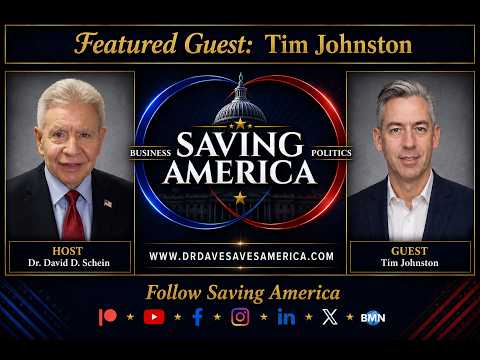
In this Saving America interview, Dr. David D. Schein speaks with Robert Peters of The Heritage Foundation about China, Russia, North Korea, nuclear deterrence, missile defense, military modernization, and the growing challenge of sustaining U.S. military power across multiple theaters at once.
Peters argues that China now presents the most serious long-term military challenge to the United States because Beijing combines a large economy, rapidly expanding nuclear forces, growing conventional capabilities, and geographic advantages in the Western Pacific.
During the Cold War, the United States faced one principal peer adversary: the Soviet Union. Peters argues that today’s environment is more complicated because the United States must simultaneously account for Russia, China, North Korea, and continuing instability in the Middle East.
He describes Russia as an ongoing military threat in Europe, North Korea as a nuclear threat to the United States and U.S. allies in Asia, and China as the most consequential long-term challenge because of its economic scale and multi-domain military capabilities.
Peters argues that China combines military power with a much stronger economic base than the Soviet Union ever possessed relative to the United States.
He also points to the geography of the Western Pacific. Unlike Europe during the Cold War, where the United States benefited from a large NATO alliance structure, the Pacific theater depends on a smaller number of U.S. allies and partners spread across a vast maritime region.
A major portion of the interview focuses on nuclear deterrence in the Western Pacific.
Peters explains that the United States removed its forward-deployed nuclear weapons from Asia after the Cold War. He argues that this decision made sense in the early 1990s but is less suited to today’s environment because China and North Korea have both expanded their nuclear arsenals.
His concern is that an adversary could believe it has escalation options that the United States cannot match locally. In that scenario, Peters argues, the absence of lower-yield theater-range U.S. nuclear capabilities could weaken deterrence.
The logic is controversial but straightforward: if an adversary knows the United States has credible proportional response options available in the theater, it may be less likely to cross the nuclear threshold in the first place.
Peters uses the term to distinguish lower-yield nuclear weapons from the very large strategic warheads associated with Cold War-era city-destruction scenarios.
He notes that the atomic bombs used at Hiroshima and Nagasaki were in the range of roughly 12 to 15 kilotons, while some later Cold War weapons reached hundreds of kilotons or even megaton yields.
In Peters’s framing, a lower-yield weapon could theoretically be used against a military target such as an air base, port, or military formation without producing the same scale of destruction as a much larger strategic warhead.
His argument is not that nuclear weapons should be used casually. It is that a wider range of credible response options can strengthen deterrence by reducing the gap between conventional war and all-out nuclear escalation.
When Dr. Dave asks Peters what he would prioritize if he were directing U.S. military strategy for the next decade, Peters gives a simple answer: more ships, more aircraft, and more munitions.
He argues that the Navy is too small for the global missions it is expected to perform, even though individual U.S. warships are highly capable.
He also advocates expanding the Air Force’s next-generation B-21 bomber fleet, increasing tanker and transport capacity, and rebuilding stocks of cruise missiles, missile interceptors, and other precision munitions.
Peters emphasizes that platforms alone do not create deterrence. A fighter aircraft, bomber, or destroyer is only as useful as the weapons, spare parts, fuel, logistics, and trained personnel available to support it.
In Peters’s view, credible deterrence depends on visible, sustainable capacity. Adversaries need to believe that the United States can continue fighting after the first days or weeks of a conflict rather than merely launch an impressive opening strike.
One of the most memorable analogies in the interview involves America’s aging nuclear stockpile.
Peters compares parts of the current deterrent to an old car that has been carefully maintained for decades but has not been replaced. His point is that extending the life of older systems can only go so far.
He argues that modernization is necessary because some U.S. nuclear systems and warheads trace their origins to technologies developed during the Cold War.
Dr. Dave raises the Cold War concept of mutually assured destruction, or MAD.
Peters agrees that the concept still matters but argues that it worked within a broader structure of flexible response options. During the Cold War, the United States maintained a wide range of nuclear systems and yields, giving presidents more steps between conventional conflict and all-out strategic nuclear war.
His concern is that today’s force structure offers fewer intermediate options. He believes rebuilding a more flexible deterrent would make threats more credible and therefore make nuclear use less likely.
The interview highlights a fundamental disagreement in U.S. defense policy.
Supporters of Peters’s approach argue that stronger forward deterrence, larger conventional forces, more munitions, and a modernized nuclear arsenal reduce the risk of war by convincing adversaries that aggression will fail.
Critics worry that expanding nuclear options or forward-deploying additional weapons could increase arms-race pressures, raise crisis instability, and make escalation harder to control.
Robert Peters’s argument is that deterrence has to be credible before a crisis begins.
That requires more than political statements. It requires ships, aircraft, munitions, missile defense, resilient logistics, a modern nuclear force, and allies that believe the United States has both the capability and the willingness to respond.
Whether policymakers agree with every part of Peters’s prescription or not, the interview makes one point clear: the United States is no longer dealing with a single Cold War-style adversary in a single strategic framework.
It is managing a more complex world in which economic power, nuclear weapons, long-range missiles, industrial capacity, and alliance networks all interact.
Policy disclaimer: This article summarizes and contextualizes views expressed in the interview. It does not endorse the use of nuclear weapons or any specific military action.
© Copyright 2026 Claremont Management Group, Inc. All Rights Reserved. No copyright asserted over US Government material or the copyrighted material of others.